“Strategy” must be one of the most overused words in American English by now.
I heard my kids talk about their strategy for catching crawfish in a nearby creek. It involved a net, a container to hold them temporarily at the creek, and a pre-arranged destination for them when they got back: an aquarium in their bedroom that didn’t already have too many other critters in it where the crawfish could live.
It sounded fun. It sounded like a plan. But was it a strategy?
When your boss comes to you and asks you to present a strategy to grow your business unit by 20% next year, what do you do?
This is where the generic use of the word strategy becomes problematic: what does your boss really mean by strategy? How do you know the strategy you present to her will actually work, and, maybe more importantly, meet her standard for what strategy means?
It starts with getting clear on what strategy means.
At its heart, strategy is about the choices we make to win in a competitive environment.
And critically, developing a strategy requires that we:
-
Understand our competitors
-
Assess the prospects of our industry
-
Decide how we compete in light of the above
The word strategy has grown so common that we use it routinely inside and outside of business – even teach our kids to use it – but this has become common only in recent years. It all started in 1980, with the publication of the book, Competitive Strategy, by Harvard Business School Professor Michael Porter.
Before that year, Porter says, “there were no systematic, rigorous tools for” developing a strategy. There was no business function of strategy, there were no professors of strategy at universities. Porter pointed out that before then, strategy was defined in the context of two dimensions: the number of buyers, and barriers to entry in an industry.
Porter’s work forever changed the landscape of how we think about business strategy.
The primary result was to take the basic reality of strategy (it encompasses the choices we make to successfully compete) and provide a basic framework that leadership can use to decide how to compete.
The Five Forces Framework
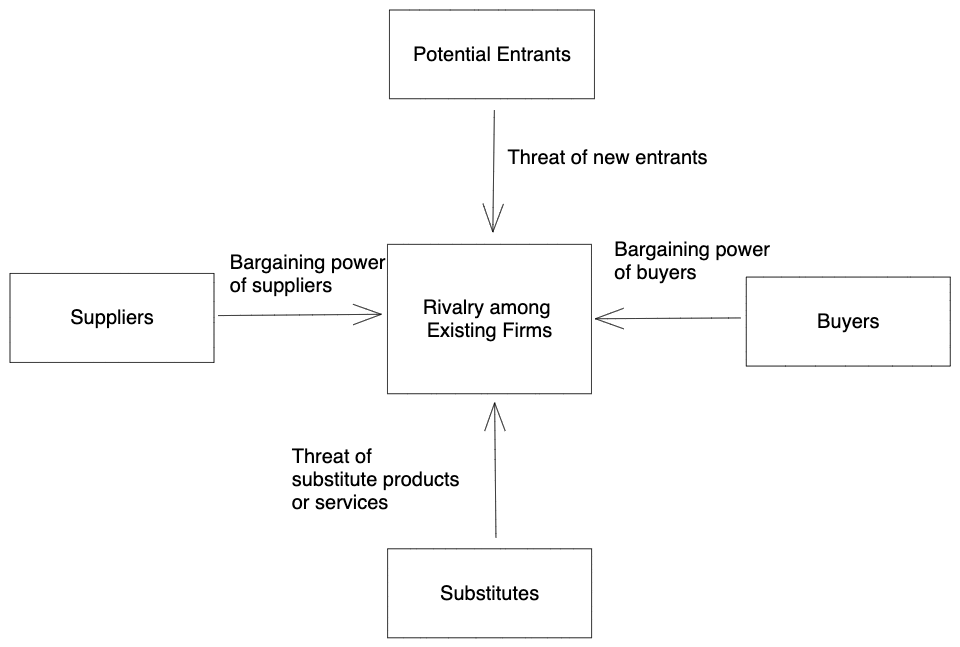
Porter went beyond the two basic dimensions, or forces, that cause business to shape how they compete, by describing what is commonly described today as the Five Forces Model.
To develop a strategy, start by looking at your company through the lens of the five competitive forces that impact it. Porter points out that,
this analysis is the fundamental underpinning for formulating competitive strategy.
At its core, such an exercise clarifies a company’s:
-
Strengths and weaknesses
-
Its marketing position relative to competitors
-
What changes to be business would be most helpful
Why? Porter contends that it:
provides a way to think about how value is created and divided among existing and potential industry participants.
The Five Forces Model
Overview of the Five Forces
Anyone can use the framework. That is the good news. Depending on the circumstances of a given business, some forces may be more or less important. It is up to the individual to decide how to apply the framework in the best way.
In general, here are the forces. Much more depth can be found in Competitive Strategy.
1. Threat of Entry
New competitors enter an industry and can take market share, drive prices down, and introduce significant risk for an existing enterprise. Barriers to entry are the way to understand the likelihood of the threat. The barriers are:
-
Economies of scale - as volume of production goes up, the degree to which costs go down.
-
Product differentiation - this normally shows up as strength of brand. Apple is probably the pre-eminent brand of the 21st century to make this point.
-
Switching costs - this relates to the customer’s pain of changing from one product to another. To stick with cars for a moment, the owner of a car with an internal combustion engine who buys an electric vehicle must incur the switching cost of having an electric charging ability at the residence (tangible) as well as a new flow to account for “refueling” when taking trips (intangible), i.e., a trip from Nashville to Destin, FL which would previously allow for making the 450 mile trip on a single tank of gas, would now require finding and setting aside time for charging.
2. Rivalry
Or, as Porter put it, “intensity of rivalry.” Rivalry shows up as how firms visibly compete: how and where they advertise, what pricing strategies, how they put things on sale (or not). Within an industry, rivalry can be more or less intense. Some of the dimensions that determine rivalry include:
-
How quickly the industry grows.
-
Whether the product or service is a commodity: without differentiation, price and service pressure is the dominant determinate of how firms compete
-
Diversity of competitors - whether a firm competes as a subsidiary to a larger organization, whether firms tend to be venture backed, or the presence of an international competitor can result in market participants bringing different goals and measures of success: e.g., some organizations may accept lower profit for expanded market share, for example.
3. Substitute Products
The most simplistic, and therefore deceptive, example of substitutes would be that of a direct competitor. Substituting a Pepsi for a Coke is an obvious substitute, but it gets much more interesting when the substitute is from a different category. To illustrate this while staying with the beverage example, Pepsi and Coke are both in the soda category, but the function they fulfill is to satisfy thirst. Water is a substitute for a Coke as well. As a result, substitutes can range far outside of what a firm considers its competing products to be. Over the last 20 years, automation has produced a bonanza of substitutes for products and services that were previously not even considered related. An app on your phone (Uber) now is an obvious substitute for a Taxi. A self-installed security alarm system sold at the Apple Store substitutes for a traditional alarm system from ADT. Which may explain, incidentally, why ADT took a $450 million investment from Google.
4. Buyer Power
Buyers – i.e., customers – can force suppliers to lower prices under various scenarios. It is in the best interest of any company to consider how much power a buyer has when deciding who to sell to. A distinctive example of a powerful buyer is Wal-Mart. They are notorious for wielding tremendous power over suppliers and forcing down costs. The reason why is that they purchase enormous volumes due to their size in the retail space. For many companies who sell to Wal-Mart, the percentage of their total sales to Wal-Mart is high compared, and they make concessions on that basis.
Overall Porter names 9 sources of buyer power, too many to elaborate here. Three others that show up most commonly include:
-
Low profits. Buyers whose own business has low profits have additional focus on driving down costs.
-
Differentiation of sellers’ products. The closer a seller’s product is to being a commodity, the easier it is to replace it with a lower cost item (overlapping with the threat of substitutes, mentioned above).
-
Buyer has complete, or near complete, information. If the buyer knows the cost structure, margins, or actual demand for products or services, they are well positioned to dictate terms.
5. Supplier Power
The circumstances that determine supplier power in general are the mirror image of buyer power. A few to highlight:
-
The product is essential to the buyer’s business. In 2021-2022, an interesting dynamic has played out in the labor force. A scarcity of talent has caused labor rates to increase drastically, due to the simple principle that a business cannot operate without people. Retailers have paid drastically higher wages for low-skilled labor, and skilled labor positions, such as nursing, have commanded large sign-on bonuses and higher rates as well.
-
The industry has very few sellers. With less competition, there is less choice, and prices increase.
Getting Started with the Five Forces
Back to the question from your boss, “what will your strategy be to grow by 20% next year?”
The answer starts with filtering what you know about your business and your industry through this framework. It continues through digging into the most relevant forces, and it wraps up with a summary of the choices you will make to harness the forces at play to achieve the goals you have laid out.